

Decolonizing Films About Africa
A comparative case study of six films to show the difference in how American and African cinema portrays the continent, its history, and its people.


Depictions of Africa and its people in American media have been shaped by the history of colonialism as well as the modern relationship between the imperialist Global North and the nations of Africa. Colonial myths and stereotypes dating back many centuries still emerge in modern representations of African culture in journalism, magazines, books, and film. By critically analyzing the differences between how American media depicts Africa and how Africans media depicts Africa, can we reveal these myths and deconstruct them. This essay will argue that these three American films– King Solomon’s Mines (1985), Blood Diamond (2006), and Tarzan (1999)– reveal how clichés, stereotypes, and racial biases paint a false picture and perpetuate myths about Africa and Africans. Then, these three African films– Atlantique (2019), Sankofa (1993), and Xala (1975)– will provide us with a more authentic and honest image of African culture and society.
King Solomon’s Mines (1985)
This is the third of six movies over the years based on the 1885 novel of the same name by H. Rider Haggard. However, the film only loosely follows the original text while adding many adventure movie tropes, making it more of a parody than a direct adaptation. Set around 1910 in the fictional region of Kukuanaland, based on real world Zimbabwe, we follow the protagonist Allan Quatermain, who is an explorer hired to lead an expedition to find the Solomon Mines.
The film starts with an archaeologist named Professor Huston being tortured and forced to translate an ancient map to lead a group of Turkish slave traders to the Solomon Mines. The professor’s daughter, Jesse Huston, hires Quartermain and an African guide named Umbopo to find her father, which they do in the fictional city of Tongola. They find the map at the House of Isis and scuffle with the owner, who was holding the professor. There’s a fight scene that breaks out where the German military Colonel Bockner teams up with the Turkish slave trader Dogati against the three of them. Realizing they can use Jesse as leverage to force the professor to help them, they try to capture her, but the protagonists get away. After failing to rescue the professor, they track down the German military train where the professor is captured and jump on. After a long fight scene, they fight off the Germans and save the badly beaten professor at the expense of telling them where the mine is. The professor insists that Jesse and Quatermain reach the mine first to stop them so his life’s work doesn’t go to waste, and they agree. The pair steal a German plane and crash close to their destination, but then get captured by an indigenous African tribe who tries to cook them alive in a large pot of stew while performing a ritual dance. They miraculously save themselves, assisted by the arrival of the colonial German military who slaughters the whole tribe. The pair gets helped by the Obugwa, a peaceful tribe who hang on vines by their feet because they are “unhappy with the world the way it is, they live upside down hoping to change it.” Then, they get captured again by a different tribe lead by Gagoola, a matriarchal figure. This group is unique in their use of face paint, feathers, and piercings. They are again threatened with being killed in a ritual, this time almost being thrown into an alligator pit, narrowly saved by Umbopo’s tribe who show up to attack. The German army joins the chaos with machine guns, shooting everyone in sight and burning the village, but Jesse gets captured by Gagoola and is brought to the Solomon Mine for a sacrifice ritual. Quatermain and Umbopo while being chased by Cornel Bockner and Dogati save her and find the treasure room. Since the treasure is sacred, the mine begins falling apart once they take the diamonds. After a fight sequence where they defeat the villains, the trio escape just in time. Umbopo’s tribe is waiting for them, and they say goodbye.
This film contains many cliches that could be chalked up to it being a parody film however, even if they are exaggerated, are still very racist. The primary trope of the film, which seems almost intentional, is the ‘damsel in distress’ trope, where, at least six to seven times, the male protagonist has to save the white woman from danger. This gets especially racialized in one scene where there are two large African men who grab Jesse, prompting Quartermain to jump in and throw a few unrealistically perfect punches to stop them. Constantly positioning the woman as incapable of defending herself and ignorant, for example, when she fails to fly an airplane, is a very obvious misogynistic trope that American film is notorious for. The sheer amount of times that Jesse is captured by a tribe or the villains is ludicrous.
In the first act, there’s a scene where Quartermain randomly goes out of his way in the middle of a chase sequence to break the shackles of the Turkish villain’s slaves. If someone was watching this uncritically, it is a brief moment but it feels interjected for no apparent reason, pretty obviously playing on the ‘white savior’ trope. Another thing that is easy to miss is the selective use of translated dialogue, where all the characters speak English just with different accents, except for the people in African tribes. The native language is not even translated for meaning, like in some films. Instead, it reads “[tribal language],” thus making them seem even more ‘exotic’ and other.
Looking at the film as a whole, Africans are in the background the entire time and never get unique screen time to show their tribal attire, they’re only visible as extras. That’s except for Umbopo, who plays the supporting role as the guide who has special knowledge of the land. This is an example of the ‘Magical Negro’ trope in critical film studies, where a benevolent black character is only there to use their special abilities or sometimes mythical insight to teach or aid the white protagonist for little or no gain to themselves.1 Umbopo is also infantilized in the film. He covers his face when there is fighting and is afraid of technology such as cars, which he refuses to ride in, instead jogging next to them. This isn’t done for any conceivable reason but to otherize him as an African man.
The scenes that feature indigenous African tribes show them in stereotypical tribal outfits holding spears as weapons. Noticeably, the men never wear shirts or anything covering their chest, which likely stems from misconceptions about what Africans actually wear. By this point in history, it’s likely that these societies would be connected to trade routes, have access to the international market, have some understanding of modern technology, and probably own manufactured fabrics. Showing Africans as primitive and backward is a key trope in the film. Umbopo wears a leopard skin, which is another false depiction of African clothing that is so prevalent in media despite being fairly uncommon in real life.
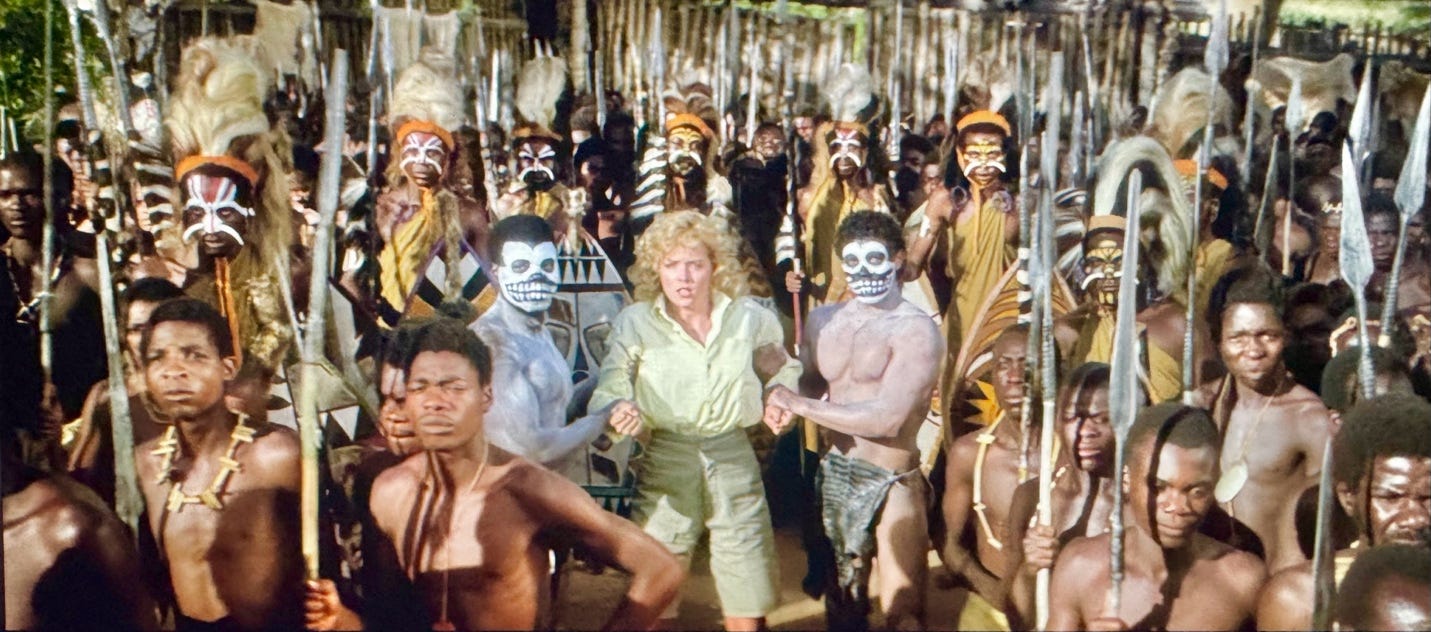
In both encounters with the hostile tribes, there is this rather odd stereotype common to these depictions where the men point spears at the protagonists and crowd around, followed by a choreographed tribal dance. It seems very unlikely that in real life, a group of warriors finding a couple of white people would throw together a whole ceremony just to invite them to the village like they are divine beings. Since the characters don’t know what is going on, there’s a trope about the ambiguity of whether the tribe is hostile or not. In real life it is probably apparent right away, and we can reasonably assume that most tribes are not as hostile as depicted in film. In both encounters, their fears are realized when they are subject to a sadistic ritual. In one case, they are being boiled alive in a stew, driving the stereotype that African tribes are cannibalistic. The choice to portray Africans as sadistic, savage people is very unsettling in and of itself.
The most egregious scene was when they meet the Obugua tribe, who are quite literally portrayed as monkeys. They live in trees in the jungle and hang upside down, allegedly because, according to the legend, “they are unhappy with the world and want to change it.” Not only that, but when they gift her a diamond crown, Jesse says, “Why are they bringing me all of these things? Maybe they’ve never seen a white woman before!” There’s not much to say about this other than that it’s racist.
There are a few positive depictions of Africans that can be found. For one, this fictional city of Tongola is very diverse, portrayed as a mix of Islamic, European, and African peoples and cultures. Another is the depiction of Mokele-mbembe, a mythical reptilian creature in Bantu-speaking cultures that is believed to live in the Congo River basin. They also displayed some of the people with a version of the cisita, a bone pierced through the septum, which is common in Batonga culture in Zimbabwe.2 However, it was definitely an appropriation of the piercing, not an attempt to be accurate to a specific real world practice.
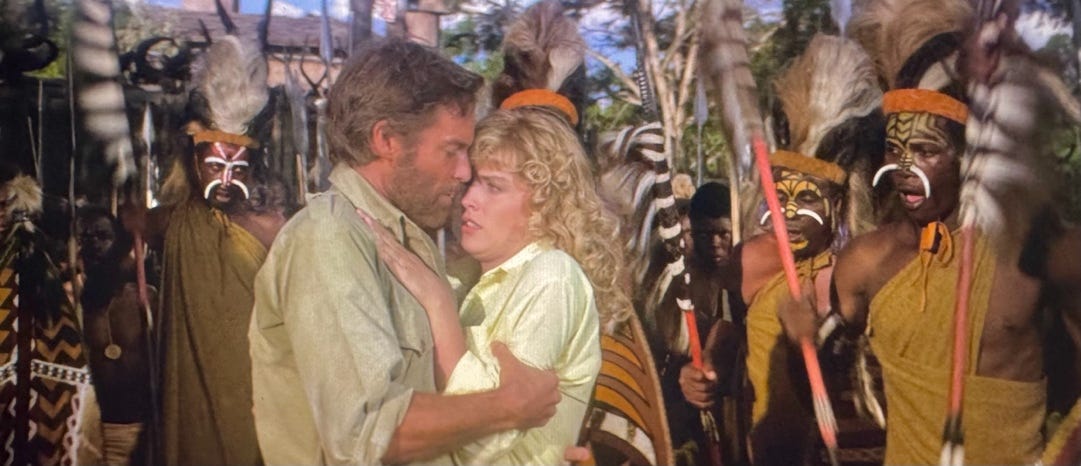
This film is directed by J. Lee Thompson, who was born in England in 1914, and served in the Royal Air Force in World War II before making movies. It’s probably fair to say that, since he grew up in the post-WWI era, that informed his decision to depict the German colonial military as the antagonist, and not the British. Though this narrative’s universe is fictional, Germany had nothing to do with Zimbabwe in real life, which makes this choice stand out since the British South Africa Company established Rhodesia in 1890. As for his portrayal of Africa, it’s fairly clear he is influenced by a British chauvinist view of colonialization and certainly didn’t do any serious investigation of African culture before writing this film.
Blood Diamond (2006)
This is an action movie based on the real life Sierra Leone Civil War of 1991 to 2002, and focuses on the issue of blood diamonds and their effect on the conflict. In the war, diamonds were used to finance the insurgent rebel army, which was particularly brutal in its campaign to claim power in the country. These diamonds were smuggled by organized crime groups into the legitimate network of trade, posing to undermine sales internationally by tainting the reputation of the industry, and by the rebels flooding the market with supply.
The film begins showing a ruthless attack on a Mende village by the Revolutionary United Front led by Captain Poison, who kills nearly everyone, taking some as slaves, some children as militants, and executing the rest. The story follows Solomon, who survives the RUF attack, and his family narrowly escapes but one of his sons is captured. Solomon is spared from execution because he is fit enough to be enslaved as a diamond miner. While enslaved, Solomon finds a massive pink diamond while panning for stones in a river, so he hides it by burying it in a hole nearby. The Captain finds out about the hidden diamond just before government troops raid the area, and then both get imprisoned in Freetown.
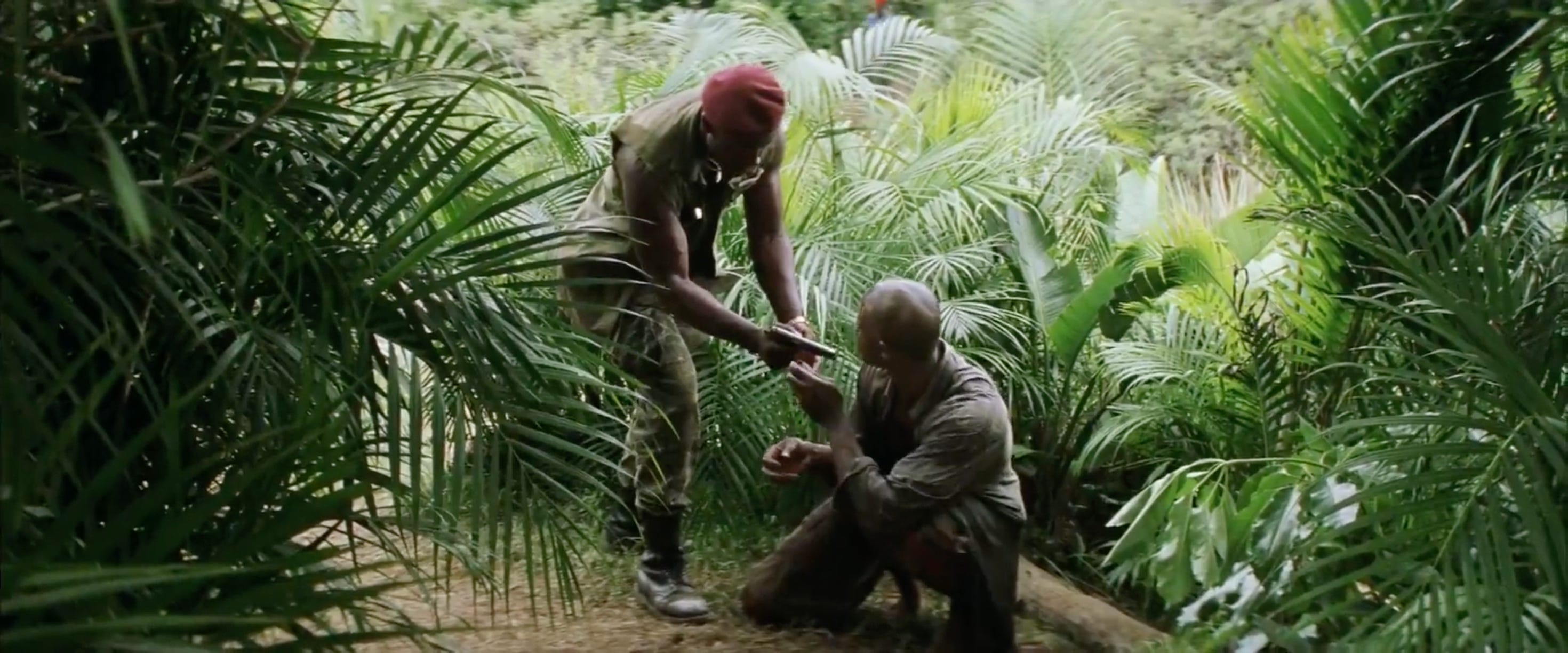
Wanting revenge for Solomon hiding the diamond from him, the Captain reveals this to everyone in the jail. This is where the second protagonist, Danny Archer, a white Rhodesian smuggler and private military contractor, overhears this in the prison. Archer is in contact with Rudolph van de Kaap, an infamous mining executive from South Africa who is buying these blood diamonds. Archer arranged for both him and Solomon to get released from prison, and they team up through their mutual interests, especially because Archer has connections. Solomon demands that, in exchange for showing Archer where the diamond is, he has to use his resources to find his family, to which they agree. Shortly after, there’s a brutal action sequence showing the capture of Freetown by rebel forces, which is a real world event in the war. It’s revealed that by now, Solomon’s son Dia has now been forced to join the RUF and is being trained as a soldier while being brainwashed to hate his family. Archer meets an American journalist named Maddy Bowen who begins having a love-hate relationship, but are also kept together by their mutual interests. Bowen needs Archer to reveal the inner workings of the blood diamond trade to write about, and Archer needs to use her for press access to other countries, as well as information on finding Solomon’s family. Eventually, Solomon is reunited with his family between a fence in a refugee camp in Guinea because the refugees can’t be released until after a ceasefire in the war. They then realize they still have to find Dia. The next leg of the journey is particularly brutal as they endure multiple ambushes, and the trio barely make it out alive to Kono. They meet with Archer’s employer, a private military contracted by the Sierra Leone government, who also happen to be planning an offensive on the RUF. Bowen stays behind and gets out of the country with her story and all the names and contacts to reveal the blood diamond trade. Archer and Solomon travel into RUF territory and find Dia, but he doesn’t show any emotion to Solomon and is instead forced to work under threat of death. Archer calls in a risky air attack on his location, causing chaos, which results in Solomon killing the Captain. Now, they’re forced to find the diamond for the head of the PMC named Coetzee, who demands payment from Archer for a debt. They find the diamond, and after one final showdown they kill Coetzee, Archer is shot and bleeds out, Solomon and Dia escape, and Maddy Bowen helps reunite the family ending with Solomon giving a speech in front of British parliament.
Since this film is based on real world events, it’s difficult to say exactly what is an honest portrayal and what may have been exaggerated since it is an action movie, not a one-to-one recreation of the events. Unfortunately, since Hollywood produces so few movies about Africa, this may be the Western audience’s first depiction of modern West Africa, giving the impression that the region is simply a violent, poverty stricken place run by drug lords. Combine this with the fact that Western media generally fails to produce any stories about Africa besides when a war is happening. The choice to make this film an action movie also does the job of sensationalizing the event into entertainment which helps plant the false idea that Africa is ‘uncivilized’ and has warlords ready to attack at any time.
Nonetheless, the depictions of the RUF in the film seem to be generally accurate; a rebel force driven by discontent with the corrupt government with brutal leaders motivated by greed. In real life, it is true that the RUF did receive funding for the war by selling diamonds. The film depicts “Operation No Living Thing,” which really happened; rebels would raid villages and have what was essentially a festival of violence where they danced, drank, did cocaine, and killed people in part to terrorize victims and gain a reputation.3 The depiction of amputations and brainwashing child soldiers is real as well.4 However, there is no analysis of the Sierra Leone government in the film, and the material reasons why rebels may want to reclaim the country even if their means of doing so were cruel and vicious.
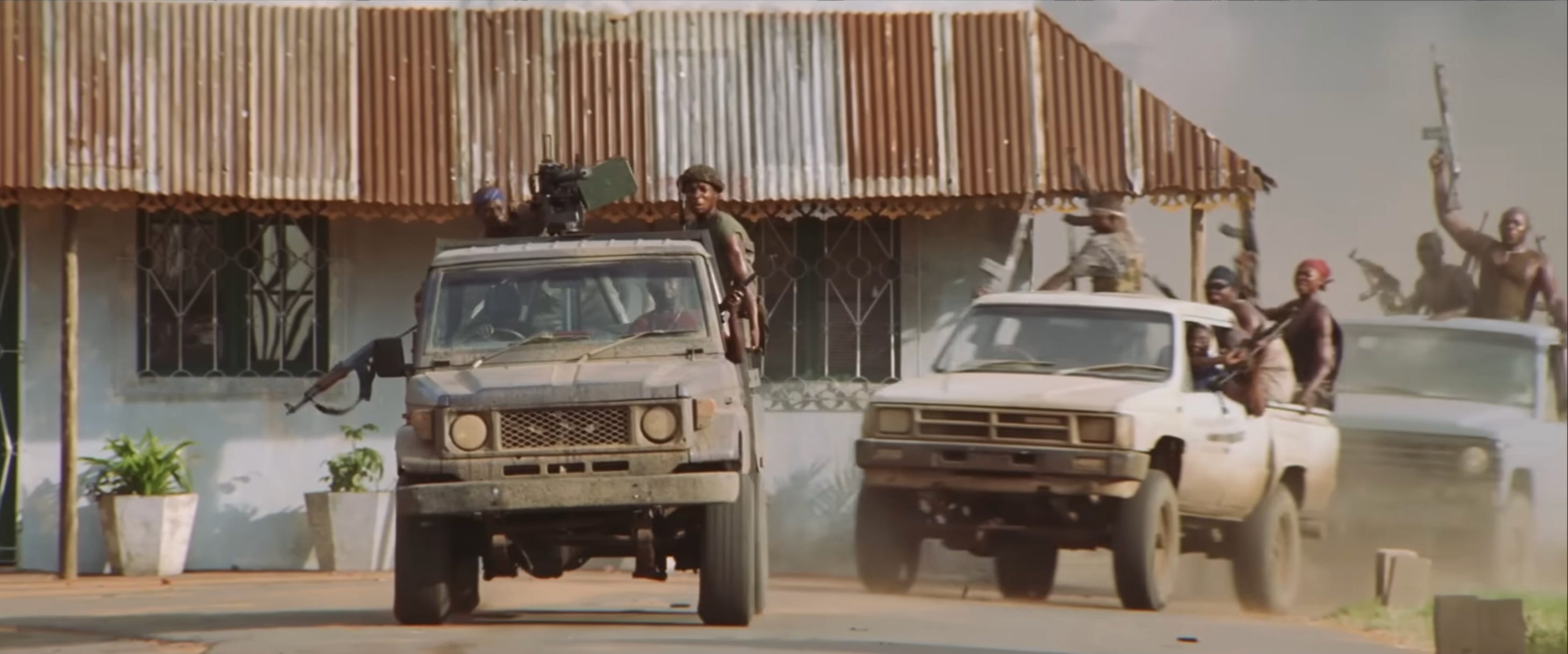
This lack of complexity is problematic because it ignores the neocolonial influences acting on both sides in the conflict, where the rebels are getting weapons and funding from Liberia, Libya, and Burkina Faso, while the Sierra Leone government is getting support from the UK and a pro-apartheid mercenary group to protect the interests of diamond corporations. The fact that prior to the war, the government was still exploiting its citizens because they were hardly receiving any public services, and that the miners were paid horribly for their work, is never mentioned. In 1971, the national diamond company NDMC was split 49-51 between the government of Sierra Leone and DeBeers Corporation (who is conveniently renamed in the movie), until it was sold to a Lebanese businessman in 1984, thus creating a new merchant class.5 Despite the movie ending with an uplifting message, after the war, not much has effectively changed; Sierra Leoneans are still extremely poor, foreign companies still control industrial mining, Lebanese middlemen still dominate exports, and even DeBeers has returned to source diamonds from ‘artisanal miners’ who are paid horribly low wages.6
In fact, one of the first scenes in the film shows a secret meeting with a bunch of world leaders where they are highly concerned about the blood diamond trade. The American representative announces a proposal, “we must act to prohibit the direct or indirect import of all diamonds from conflict zones.” The diamond industry representatives even agree, despite them saying conflict diamonds make up 15% of global trade. This extremely simplistic depiction serves to whitewash how Western governments really operate. Historically, capitalist nations have never cared about issues like this for humanitarian reasons, and when they have, it was never proactive or without ulterior motives. Ironically, the leaders say, “whenever a substance of value is found, locals die in great numbers and in misery,” which is often true, but it completely leaves out the fact that capitalist corporations are ruthlessly driving demand for that substance.
In that end credits scene, they mention the Kimberly Process which is a method of certifying diamonds to ensure that they go through ‘legitimate trade’ networks and aren’t coming from conflict zones. This is portrayed as if the UK and Western governments were suddenly awoken by this civil war and suddenly wanted to institute humanitarian policies to help the people of Sierra Leone. However, this measure was purely to cover the tracks of the diamond companies after the war, it was never meant to actually solve the problem. If anything, things have gotten worse for citizens as mining operations have displaced people, destroyed the environment, and the profits extracted have not helped locals in the slightest.7 This problem is especially bad in places like the Congo today, where cobalt, a resource needed for batteries powering all our electronics, is extracted at the local peoples’ expense.
A small, easily missed detail is that they chose to use hip-hop music in most scenes with the RUF. When they are raiding a village, killing people, or ordering slaves around, hip-hop music is playing. This may be historically accurate, but hip-hop is nowhere else in the movie, it seems to be specifically used to symbolize the bad guys, making it difficult to believe it wasn’t intentional. Since this was made for an American English-speaking audience, it’s not a stretch to imagine this is meant to play on the racist idea that hip-hop is a culturally degenerate or even socially corrupting.
Another odd choice is to include the acronym “TIA,” which means “This is Africa.” In real life, this is used when something fails or gets in the way, a sort of ‘wry acceptance’ of things that go wrong in daily life.8 In the movie, however, it’s used in a very dark way to justify killing and brutality. For Archer, it’s his way of explaining the twisted things that happen to him make it seem like these horrors are ‘just how it is.’ The appropriation of this term in the film is wrong in and of itself, but to use it in a film about a horrible civil war to say ‘This is Africa’ is literally telling the audience that Africa is a dangerous place.
Looking at the director, Edward Zwick’s other works, he seems to use the white savior narrative a lot, especially in The Last Samurai and The Great Wall.9 In Blood Diamond, this comes up again, but it’s not just any white man. Archer is a white Rhodesian who fought to uphold apartheid in Zimbabwe, and he even tries to justify it by saying he fought alongside Black Africans. Given that anyone could’ve filled the role in the film, at best, it’s a poor choice, at worst, it also allows the character to redeem his white guilt and go from morally ambiguous to the savior. Lastly, this film is filled with Afropessimism. Every major character in the film is acting out of self-interest and talk about how they want to get out of Africa (not just Sierra Leone). This is summed up when Archer outright says “God left this place a long time ago.”
Tarzan (1999)
Based off of the 1912 novel by Edgar Burroughs, Tarzan is a classic animated kids movie by produced by Disney. The story begins in the 1870s when a British ship crashes off the African coast, and a couple survives with their infant building a treehouse. The mother and father are killed by a leopard, and the baby is found by a gorilla named Kala, who adopts him, naming him Tarzan. Though different from the gorillas, he is allowed to stay in the gorilla troop to be raised with them. Skipping to his childhood, Tarzan is friends with Kala’s niece, Terk, and a young elephant named Tantor. Tarzan is treated differently because he looks different and cannot earn the respect of the troop leader, Kerchak, his adoptive father. Tarzan grows over the years, becoming more skilled and fit. One day, the same leopard that killed his parents, Sabor, ambushes the gorillas, but Tarzan kills her, protecting the troop, thus gaining the respect of Kerchak. The animals in the jungle hear a gunshot which came from a British explorer Archimedes Porter, his daughter Jane, and the hunter Clayton. It turns out, they are searching for gorillas to study.
The three get separated when baboons attack them, and Tarzan saves Jane leading to the realization that she is a human just like him. They go back to the British camp where Porter studies him because he is a man who acts like an ape. Tarzan learns how to speak broken English, and they teach him what it’s like to live in Britain using a projector screen. Porter and Clayton hope to have Tarzan show them the gorillas while Jane is interested in him romantically. They also want to bring him back to Britain with them to study, but Jane tells him he won’t be able to return.
After Clayton lies to Tarzan, he agrees to show them the rest of the troop, but Kerchak is furious that he would invite outsiders. Tarzan fights Kerchak to stop him from harming Jane, Porter, and Clayton. Tarzan is reprimanded for betraying the troop and leaves them. Tarzan goes to the treehouse and Kala reveals how she found him. He says “You will always be my mother” before leaving for Britain.
When they board the ship, Clayton’s men betray Porter, Jane, and Tarzan, locking them in the ship, planning to capture the gorillas to sell. Terk and Tantor come to save them while Clayton and his men head out into the jungle that night. Tazan is freed and arrives just in time with a pack of elephants to stop Clayton, but not before he fatally shoots Kerchak. Tarzan fights him, causing Clayton to hang himself on a vine. In his dying breath, Kerchak finally realizes Tarzan is “one of us” and says he should lead the gorilla troop. In the final scene, Jane decides to stay with Tarzan in the jungle.
Being a recreation of Edgar Burroughs’ story called Tarzan of the Apes, this rendition of the story makes a few key changes. First, Sabor, who kills Tarzan’s parents, is a leopard as opposed to a lion in the book, which is more accurate because leopards are actually the animal that lives in the jungles of equatorial Africa. The movie also makes the Porter family British rather than American in the novel. Since it’s a children’s movie, it makes Tarzan a pacifist and there is very little violence overall, whereas the book describes him as a “killer of beasts and many black men,” and wages a brutal war of revenge against the African tribes. In the novel, Tarzan also kills for food, pleasure, and vengeance, portraying him as uncivilized, or even sadistic. The ending as well is much different, instead of living happily-ever-after, Tarzan follows Jane back to the United States and ends up saving her from a forest fire, but she believes he is a too uncivilized to marry, ending in heartbreak.10
The source material for this movie is extremely racist, written by an author who openly believed in racial hierarchy and justified it with ‘race science.’11 Burroughs even lived in a sundown town in Chicago so it’s no wonder he portrays his white Tarzan character as a superhero-like figure who can talk to animals, nimbly swings from trees, and brutally kill local African tribes often hanging them from trees. Though Disney took out all of this overtly racist imagery, the choice to even use such a story is a eyebrow-raising decision in and of itself, especially being one of their only films set in Africa. The writers already had to completely diverge from the source material to make it family-friendly so they certainly could’ve done more to flip the original script. In the process of adaptation, Disney removed all Africans from this film set in Africa. This ends up leaving a fairly big plot hole: why is Jane the first human Tarzan ever encounters in his life? Surely there are Africans that he would’ve came across.
As for the major themes of the story, it’s mainly about accepting others even if they are different than you, and that familial love is not bound by relation. Kala accepts Tarzan despite him not being her own son, and Jane falls in love with Tarzan despite them being so different from each other. It also offers a subtle critique of colonialism, though that may not be fully understood by a younger audience. The villains being poachers who want to capture gorillas for money is at least a good portrayal to show kids, especially since the animals are more compassionate than the humans who are driven by greed.
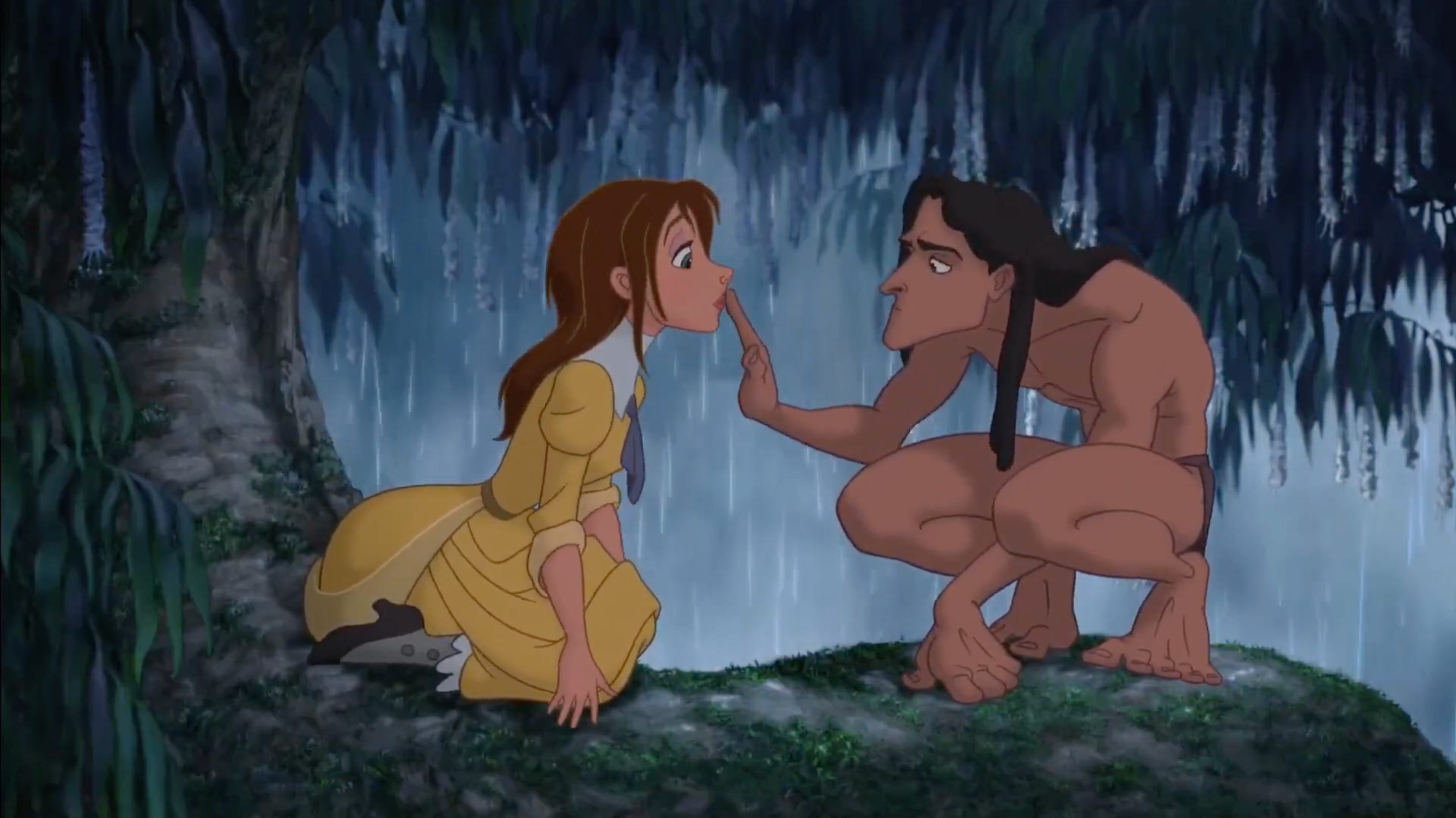
The film does have some problematic undertones to it, specifically with how the gorilla troop is treated as the ‘natives’ that aren’t supposed to leave Africa, while Tarzan is the white human who is meant to live with other humans in Britain. Tarzan gets ‘civilized’ and taught English, so it positions the British has ‘enlightened’ in comparison with the man who was raised by gorillas. Thus, there is a bit of the white savior trope since Porter is trying to ‘save’ Tarzan and bring him back on the ship to be studied. Also, there is something to be said about Tarzan overpowering Kerchak, the patriarch gorilla, which is obviously extremely unrealistic but it makes him out to be superior.
Lastly, Bohannan & Curtin’s Africa and Africans describes the “myth of the lions in the jungles” which is very applicable since this film helps perpetuate the idea that Africa is a continent of just wilderness.12 As they describe “Only about 5 percent of the African continent can be called jungle in any case.” Prior to the release of this movie, Disney has only released four films about Africa: The African Lion (1955), The Lion King (1994), George of the Jungle, and The Lion King II (1998), all of which, based on their title, are all about the jungle or wildlife. It’s extremely chauvinistic of Disney to contribute no fair portrayals of Africa or tell any African stories after so many decades. So, whether intentional or not, the film Tarzan (1999), only serves to reinforce this image that Africa is one big jungle.
Xala (1975)
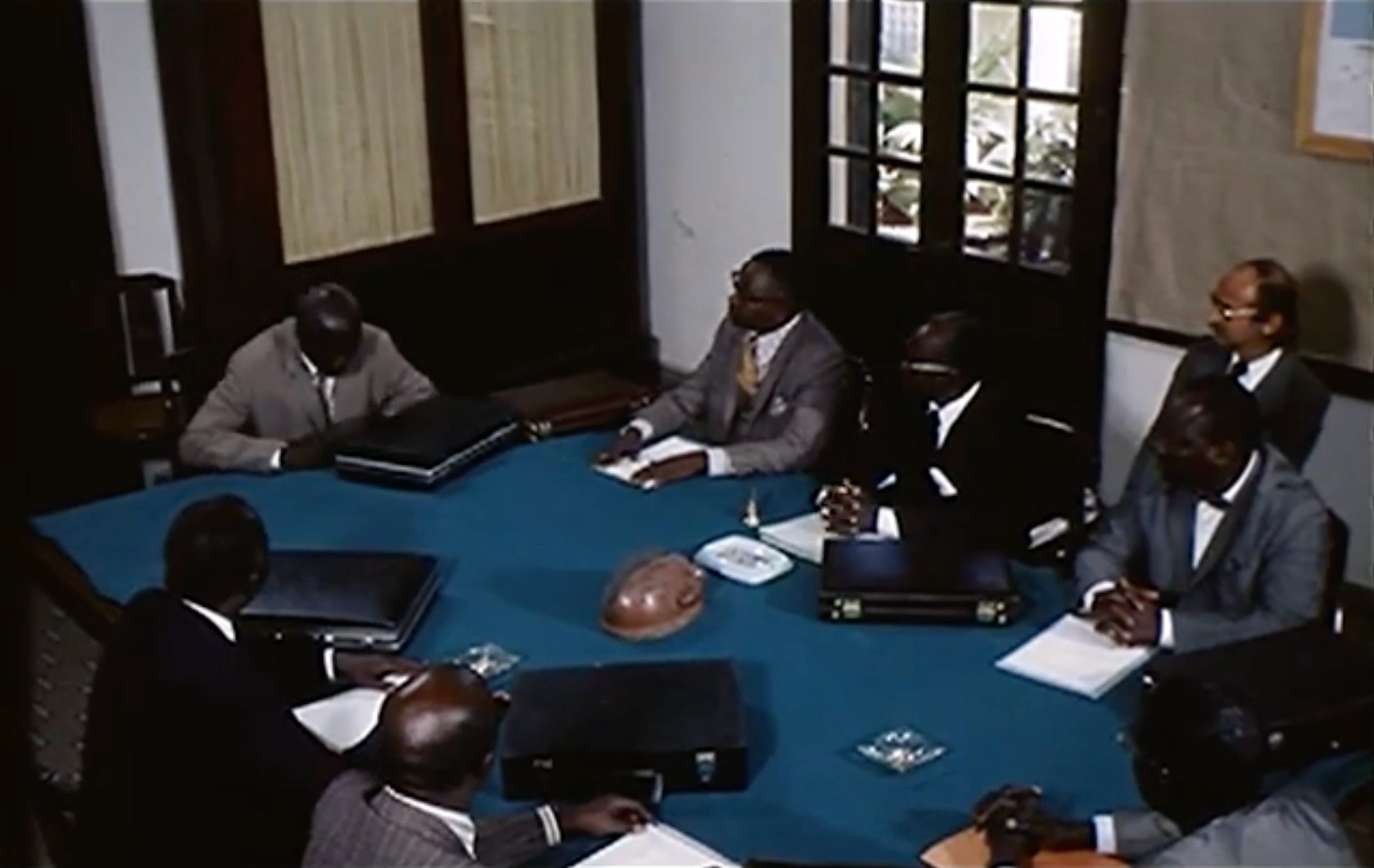
Directed by Ousmane Sembène, Xala is a Senegalese comedy film which adapts Sembène’s novel by the same name. The word Xala is a Wolof word for temporary sexual impotence which is the primary conflict in the film. The main character El Hadji is a wealthy businessman in Senegal shortly after the end of the colonial era. In the first scene the colonial governors are kicked out of the chamber and the new African Senegalese government declares itself independent from France. The French white men who just walked out now come back in the room with briefcases and hand them to the African bureaucrats, they nod along presumably accepting a deal, and they all are invited to a wedding.
El Hadji is marrying his third wife because to his business success brought him a lot of wealth. His other wives named Oumi and Adja disapprove. This woman, Ngoné, is much younger and is the daughter of a wealthy family. El Hadji refuses his soon to be mother in law asking him to perform a traditional custom where he puts a mortar and pestle between his legs to prevent bad luck. After the wedding ceremony, El Hadji is supposed to have sex with his newly wedded wife, but he has an erectile dysfunction, and thus he perceives to have ‘lost his manhood.’ El Hadji was offered medication for ED before but turned it down saying “I don’t believe in those ridiculous things.” He then goes to various people offering rituals to cure the curse of impotence that has been placed on him. He pays these people handsomely but nothing seems to work. At one point at a business meeting with the President in his store, El Hadji tells him to call the police to remove the beggars from the street who he calls “human rubbish.”
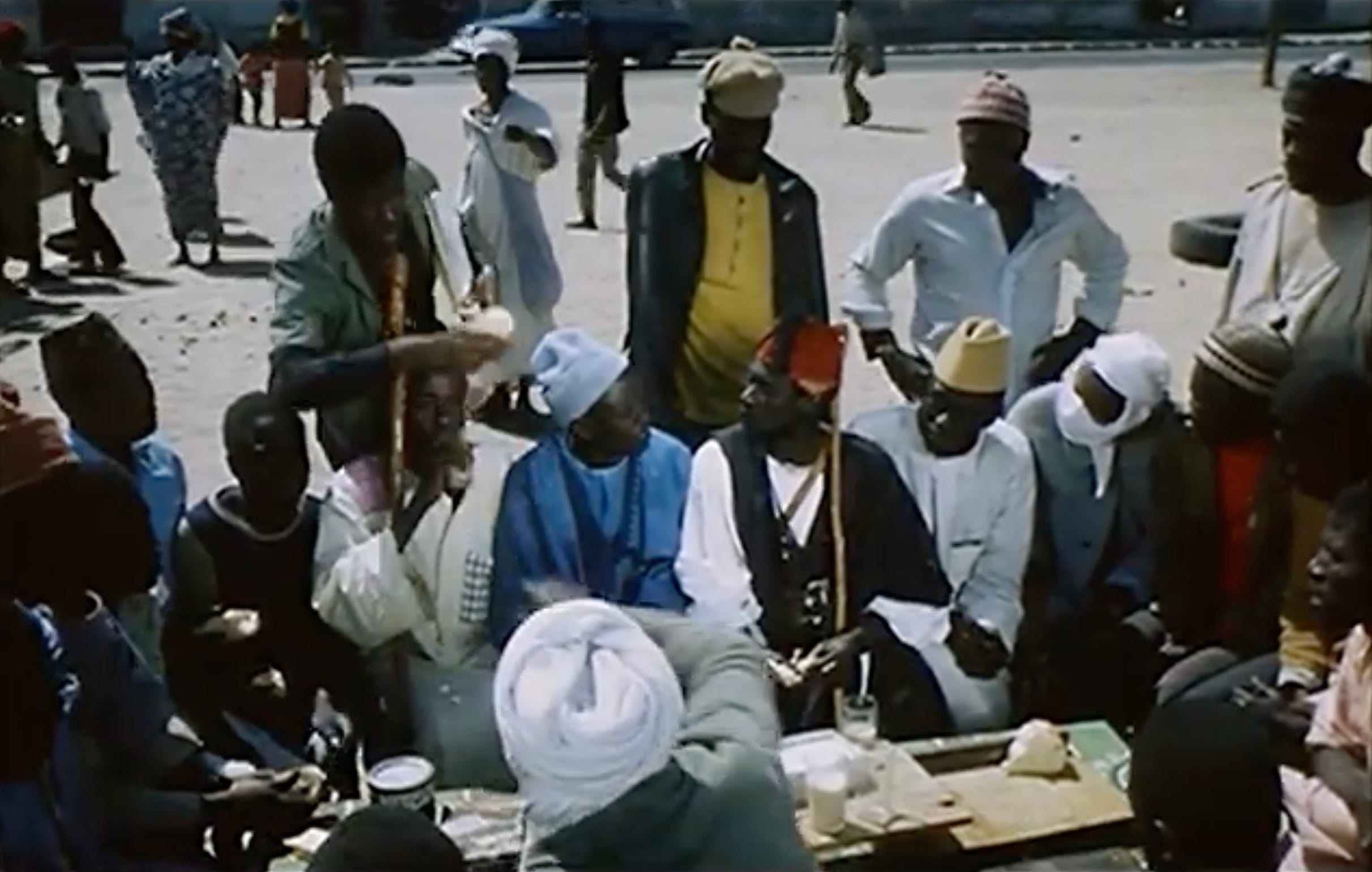
Eventually, he finds a marabout who finally lifts his curse but is warned that the curse could return, and pays him with a check. Since Ngoné gets her period, he isn’t able to consummate the marriage yet. Meanwhile, his business begins to fail and the check he wrote bounced, meaning he spent all his money trying to solve his impotence. The Chamber of Commerce convenes and votes to remove him from the board. His businesses and property is seized, and the marabout returns telling him the xala could come back. By the time he returns home from this, his second wife has already taken what she could and left, and his third wife’s wedding gifts have been taken back by the family. The beggar we saw earlier in the film returns, telling him “I warned you. What one hand removes, another can put back.” He tells him can fix the xala leading him and the group of disabled drifters to El Hadji’s home where they pick through his kitchen for drinks and food. Revealing that he is a person who El Hadji defrauded many years ago, stealing his inheritance, and getting him thrown in prison, he was the one who put the xala curse on him. The only way he will agree to lift the curse is if he strips naked and gets spit on by the group, to which he agrees, completely humiliated.
The story of Xala is very silly and unique on its surface but has some very important and powerful messages underneath it, namely the portrayal of the post-colonial world. In metaphor, Sembène is showing us the transition from the colonial government, who exerted overt oppression, to independent African-run government who co-opt the imagery of freedom while still oppressing the population. Right from the beginning, the French diplomats literally pay off the African bureaucrats and El Hadji uses his share to benefit his business and get married for a third time. It is revealed that the whole time, he was defrauding people and taking their inheritance leaving them destitute. This portrayal is likely referring to how, in real life, the Senegalese bourgeoisie, and leaders like Leopold Senghor, betrayed the people by allowing neocolonial French rule in the form of military presence, monetary policy(CFA franc), and surrendering economic control to impoverish the country.13 The metaphor may even go as far as El Hadji’s impotence, much like some post-independence African leaders who were, at best, ineffective in resisting European control, or at worst, corrupted and actively selling the nations’ future for money and power.
One step further, this is reminiscent of a central theme of Franz Fanon’s book Black Skin, White Masks where he critically analyzes how European colonial behaviors manifest in African society and especially in African elites.14 The film shows how El Hadji and the bureaucrats treat the poor Senegalese, calling them “rubbish,” having them arrested because it “looks bad for tourism.” Though it may be fair to say the wedding scene was showing a mix of culture, it seems a bit more Western and commercialized especially with the men wearing Western-style satin suits. El Hadji even refuses to perform a common wedding ritual displaying his aversion to traditional African norms.
How women are treated also tells us something important. El Hadji’s first wife, Adja, more or less represents a role as a traditional wife, being subservient, wearing traditional clothing, being a voice of reason, and adhering to Islamic principles. She could be representing women under religious patriarchy present in the colonial and pre-colonial era. His second wife, Oumi, wears a more revealing dress with her hair in an afro style, she is much more outspoken, and sees his third wife as a threat. She is the one that demands money from El Hadji, she walks confidently, and says “we women must stick together” at one point. She may be representing women living in a consumerist, post-colonial patriarchy. His third wife, Ngoné, is the youngest, even being referred to as a ‘little sister,’ she is completely servile in what is presumably an arranged marriage. Her virginity is discussed with great importance, something which is reminiscent of European royalty or Victorian era purity. Ngoné is lectured that she needs to obey her husband because he is the master. She may be embodying how women found themselves under both the traditional religious patriarchy and capitalist patriarchy around this time, and how both became oppressive forces in their lives. On the other hand, though she only appears briefly, Rama, his daughter is more fiery, she rejects the European influence, refusing to speak French, and refusing to drink imported water while denouncing El Hadji’s polygamy. She represents the new spirit of resisting the neocolonial influence wherever it appears in society.
Different from American Hollywood cinema, Xala, written by Ousmane Sembène, is a very political film. The primary force of the film is not necessarily the characters and the world of the movie, it is the thematic metaphors that represent real world problems. Where Hollywood typically addresses very abstract themes (i.e. the power of love, coming of age, dealing with death, human vs nature, perseverance, revenge), Sembène roots his film’s theme in material issues; in this case critiquing post-colonial governments and the effects of neocolonialism. This is certainly created less to entertain and more so to educate and satirize. On its face, the raw visuals of what is happening on screen is rather insignificant, there isn’t bombastic action sequences, bloody fights, or hair-raising reveals. What is important is how Sembène asks the viewer to look deeper and to find the significance through allegory.
Sankofa (1993)
Sankofa is an Ethiopian film directed by Haile Gerima which depicts a woman being transported back in time to relive the experience of her ancestors in the Southern United States. It explicitly addresses how African Americans and others in the African diaspora have been alienated from their ancestorial past and even can find themselves disrespecting this past after living in the West for so many generations. The film invites the audience to think critically about their past and the importance of not forgetting it. That is expressed in the film’s title which means “to go back and get” in Akan, an indigenous language of Ghana.15 The symbol Sankofa is represented by a bird with its head turned back which is portrayed in the first scene accompanied by a voice saying “rise up and claim your bird of passage.”
The film begins at Cape Coast Castle in Ghana, one of many slave trading commercial forts on the Gold Coast of West Africa which shipped an estimated 3 million slaves to the Americas.16 Mona, an African American model is doing a photo shoot on the beach seemingly unaware of the historical significance of the landmark. She puts on a kufi and kente pattern robes, likely representing her naivete, and continues the shoot in the fort. A man with a staff bearing the Sankofa bird at the top approaches and yells at her to “Return to your past!” then chases some tourists away. Seemingly shaken, she walks around the fort in solemn introspection. In the underground belly of the fort, she begins hallucinating. Mona sees dozens of Africans chained up looking at her sternly. She tries to run away but she can’t escape as they follow her until she runs into slave traders who grab her, strip her, and brand her with an iron.
Mona wakes up on a slave plantation in the American South where she is now Shola. During her time in this dream she suffers physical abuse and rape under control of the slave master. Among the characters introduced are Nunu, a motherly figure with a deep seeded rebellious attitude, Noble Ali, an African slave driver who is conflicted about his loyalty to his fellow Africans and the duty forced on him, Shango, a rebellious spirited man who desperately wants freedom, and Joe, son of Nunu is a mixed race man who is deeply religious and abandons his African heritage, seeking to find freedom by aligning with the white man.
Shango is very loyal to his fellow Africans and refuses to run away because he cannot leave them behind. Some slaves got captured after trying to run away because one of them was about to give birth and they were brought to be whipped. Shango tries to free them but is shot, while the slave master is distracted, the others run and protect the pregnant woman. She presumably dies after the whipping while her baby delivered.
There is a secret society in the caves where many slaves meet at night where to talk about rebellion. Shola is conflicted on whether to join because of her Christian beliefs. Meanwhile, we’re shown Joe connecting with his faith in the church where he is taught that Africans are lesser than and that the slaves on this plantation are devil worshippers. Nunu and Noble Ali are in conflict since he is a headman who betrays the other slaves. He says the eyes of the other Africans “torture” him with guilt. Nunu tells him he can either be a true man or a beast and refuses to be with him so long as he’s a headman. Shola is in love with Shango who is now being flogged for revolting by himself. She scolds him for almost getting killed but he explains that the only way to freedom is collective revolt.
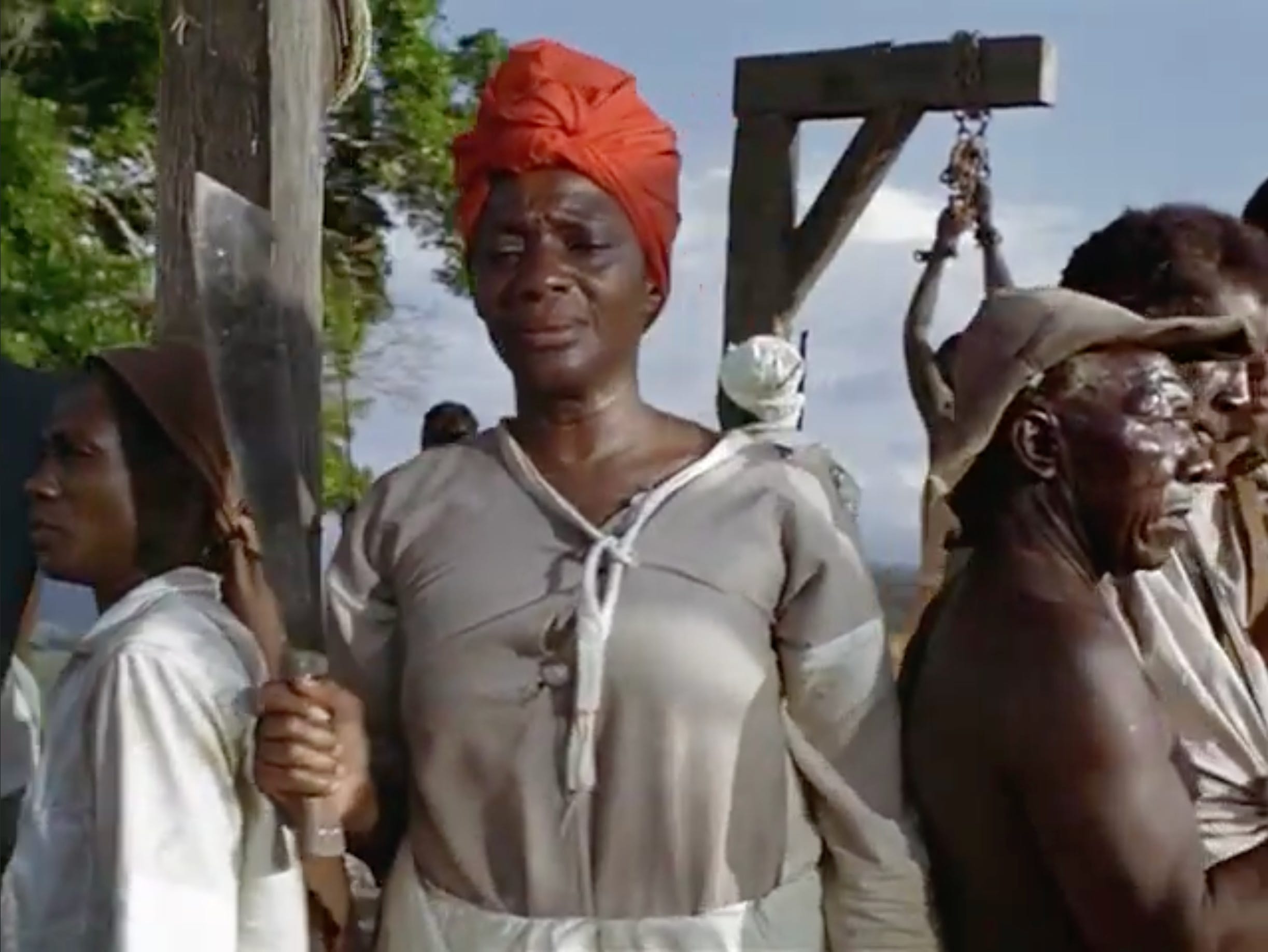
One night, the secret society burns down the sugar cane fields, but the rebellion is put down by soldiers and armed men from the neighboring plantations. The masters make an example out of the field hands who refused to say who was responsible by hanging them in cages in trees until they were eaten by vultures.
Nunu was going to be sold shortly after which finally convinced Noble Ali to join the rebels. Luckily no one bought her at auction and she comes back. Lucy is in love with Joe and tries to have sex with him, but he can’t do it because of his faith. She goes to Shango asking how to win his love and he tells her to poison him. Shola runs away one day spontaneously. After being captured, she is told she is possessed by the devil, and is whipped. Shango visits her bringing her herbal medicine for the wounds and convinces her to join the secret society. In that moment, Shola becomes a rebel saying that death no longer scares her.
Joe is afflicted with the poison and his mother Nunu holds him by the river as he writhes in pain. Seeing his necklace from the church she throws it away prompting him to lash out and murder her. Joe begs to Shola for forgiveness but she rejects his pleas screaming “Which one of them white men raped your mother?!” Joe carries Nunu’s body back to the church to pray but Father Raphel doesn’t let him, saying she is a “heathen creature” with no soul. Joe murders the priest, locks himself in the church for days, and the slave masters burn it down with him inside.
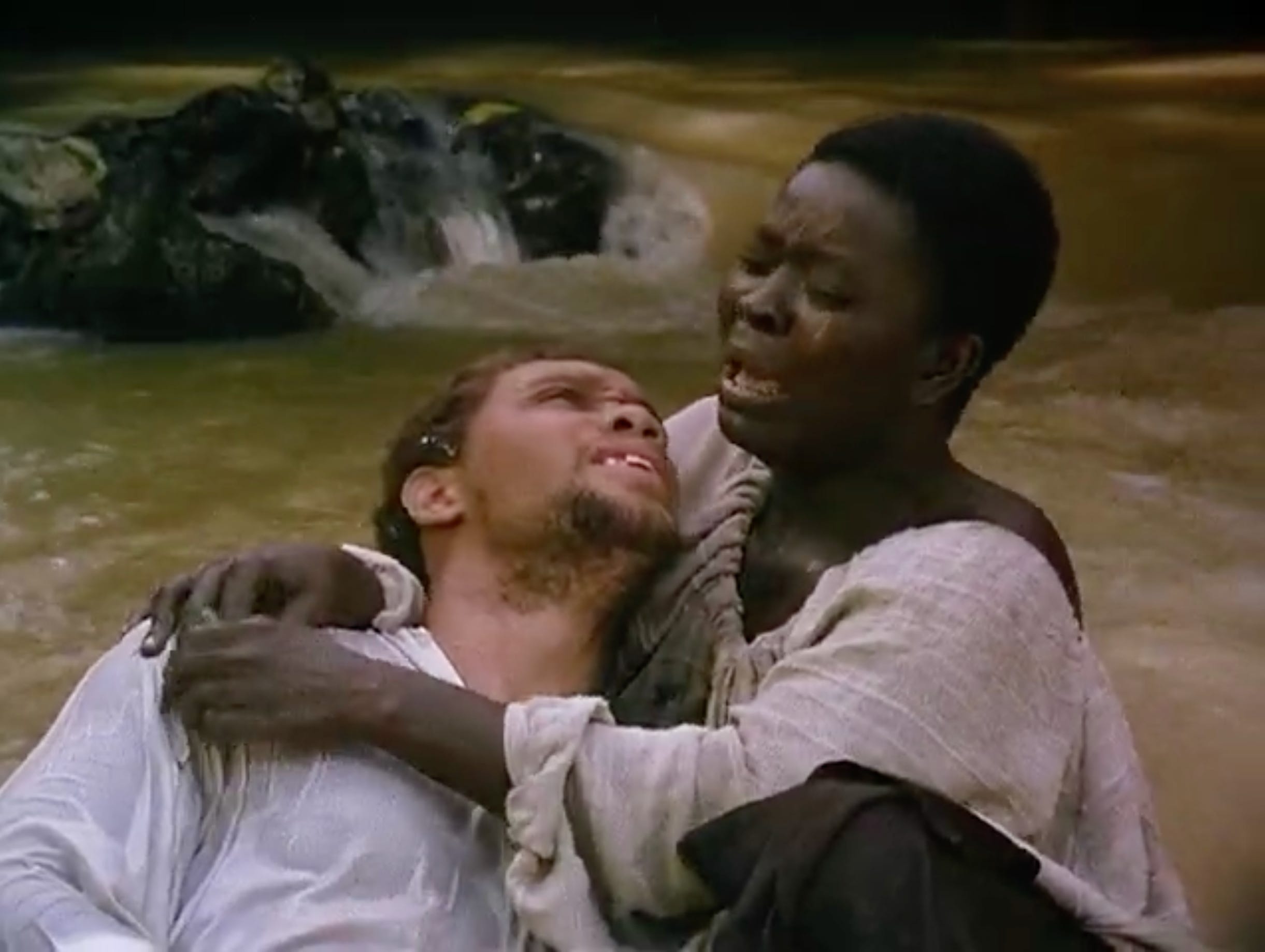
In the final act, the secret society wages a rebellion by stealing the master’s gun and attacking with machetes in coordination. While this is going on, Shola confronts the master who raped her and hacks him a machete until he’s dead. She runs away desperately, the dogs and the horses catch up with her and she is presumably killed along with the rest of the rebellion. In her last moment, instead of pain, she feels lightness, her legs don’t feel tired, and she feels uplifted by a buzzard(bird) and is flown back to her home in Africa. Out of the dream now, Mona realizes her roots and joins in honoring the spirits of the dead.
We can see that this film is dense with meaning. Most apparent, the film overtly is asking the audience to recognize and respect the history of slavery and for Africans to reconnect with their heritage. The film distinctly upholds resistance as righteous and necessary, sharply condemning alignment with whiteness while centering unity among Africans.
While being flogged, Shango says to “the snake will eat whatever is in the frog’s belly.” The analogy of the frog represents the oppressor that consumes all the fruits of their labor, and the snake is the Africans who need to wait for the right moment to strike. In order to liberate themselves, they have no choice by tot destroy the oppressor completely, everything inside the frog’s belly, including the headmen slaves who help the oppressor. That is the cost of resistance and the internal conflict each of them goes through. Ultimately, they overcome this internal conflict and are saved by the Sankofa bird and brought home to Africa when they die.
The characters Joe and Noble Ali are both essential characters to the narrative. Both are in positions of power which betrays their fellow Africans and both are utterly humiliated for it. Being a headman, Noble Ali is denied by Nunu who is strong willed and refuses to love someone who sides with the oppressor. This social sanctioning eventually leads him to support the resistance. Joe is much closer to whiteness and is given privilege for being mixed. He struggles with his belief in Christianity, which still treats him as lesser than, showing the cognitive dissonance of siding with the oppressor. He is shown covering his eyes and ears when he has to watch slaves being whipped and when Lucy yells at him for rejecting her, ironically very similar to how Umbopo was infantilized, covering his eyes when there was fighting, in King Solomon’s Mines. In the end, he cannot reconcile this conflict and self-destructs, murdering both his mother, representing his true African identity, and the priest, representing the oppressor. It is an important detail to realize that Nunu gave him love even when he didn’t deserve it while the priest gave him hate when he was weak.
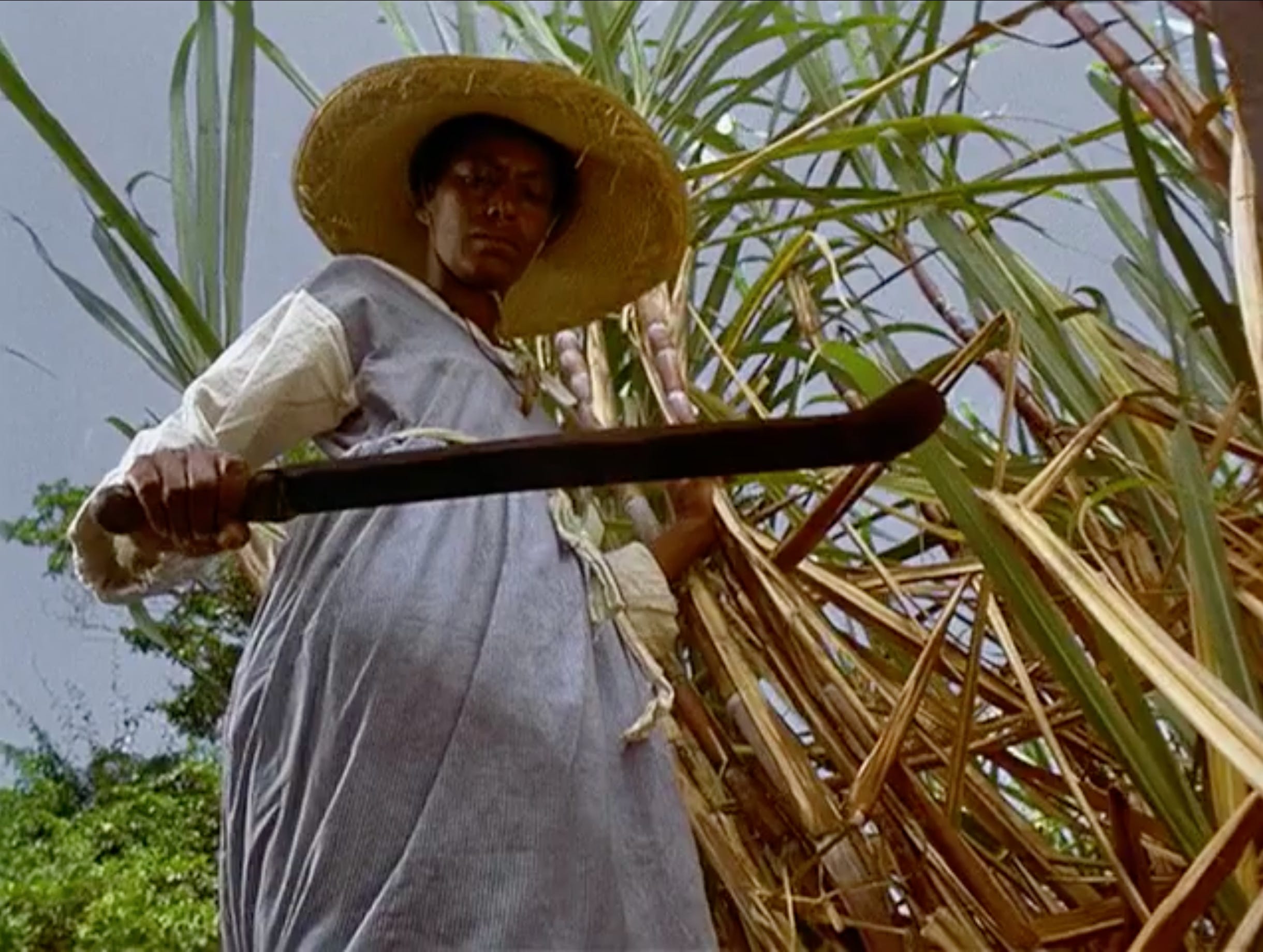
This film smashes many tropes in American film. It firmly rejects the notion of Afropessimism and refuses to present this story about slavery as purely a trauma porn (for lack of a better term). Sankofa is first and foremost a story of liberation that shows the nobility of struggle. There is nothing tragic or futile in resistance, as if to say “It is better to die on your feet than to live on your knees.”17 It unapologetically centers Africanness itself as virtuous and positions Africans as active agents in their own liberation; they aren’t helped by a white savior or portrayed as passive victims. This is not just entertaining, as it does have some great visuals and drama, but also to inform and motivate the viewer to change their perspective on history and our place in it.
Atlantique (2019)
Directed and written by Mati Diop, Atlantique is a romance drama film set in Dakar, Senegal. It deals with themes of loss, grief, sacrifice, class, and love. While most of it is rather sad, dealing with heavy real world problems, it does come back to end on a note of acceptance and harmony.
The first scene features Souleiman, a young construction worker who is part of building these large skyscrapers in a dusty landscape. All the workers get off the job and are once again denied pay after months of excuses. This leaves them no choice but to leave the country for Spain to find work. We find out that Souleiman has a love interest named Ada who he meets up with one last time in an abandoned building by the water. She expects to see him again that night but he hides the fact he’s leaving. He gives her his necklace knowing he won’t be seeing her again but.
Ada is actually engaged to an wealthy man named Omar and is marrying him in 10 days, to which her friend reminds her she can’t be unfaithful. At the bar where she was supposed to meet Souleiman, there are many girls who look disturbed, a girl tells Ada that they left by sea that night. In the following days, she is very depressed, not eating as her wedding day approaches. Omar gifts her an iPhone but she doesn’t feel anything. On her wedding night, her and her friends see the lavish bedroom she will be living in, but Ada is unimpressed, still worrying about Souleiman. Later, the bed in her room starts on fire seemingly randomly causing a scene. It is suspected to be an arson attack and is being investigated by Issa, the detective.
Ada then falls under increasing blame and thus is thought of as unfaithful. She is interrogated and forced to take a virginity test which comes up negative. Ada’s friends and others in the town are falling ill and we catch glimpses of mysterious people with all white eyes. Issa falls ill as well, loses control of his body, and wanders aimlessly around the city. There are spirits who possess the bodies of the people who fell ill and now walk around in their bodies at night. The spirits haunt the real estate owners of the massive building projects who refused to pay the workers.
Issa finds out about Ada’s relationship with Souleiman and accuses him of starting the fire. Ada is put behind bars to be interrogated again. It’s revealed that the ship went missing, and later that all the men who left for Spain including Souleiman died. The spirits are really the men who died on the ship and now want justice. Omar picks Ada up from jail and she yells at him “I am not your wife! I don’t love you!” thus breaking off their marriage and walking home.
The spirits in possession of Ada’s friends’ bodies burn down the house of the real estate owner. Issa, now possessed by Souleiman, visits Ada in her home but she is afraid, running off to the Atlantic coast. At the bar, all of the girls are possessed by the spirits indicated by their white eyes. Ada is told how Souleiman regrets not saying goodbye and that he wanted to come back for her. Issa reviews the footage of the wedding night and is shocked to see himself with white eyes in the background. As the sun goes down, he is afflicted with the illness again barely getting home in time to handcuff himself in place before being possessed.

This night, the spirits convene on the beach accepting their ransom from the real estate owner after threatening to burn the whole town. Before he can leave he is forced to dig their graves so they can rest. Issa, again possessed by Souleiman, meets with Ada in the bar and they have one last intimate moment together, having sex on the floor and falling asleep. When Issa wakes up, he goes to the commissar and cancels the investigation. Ada accepts that Souleiman is gone and is now at peace.
Atlantique is very beautiful film in its cinematography, the subtleness of the sound design, and the precision of the narrative. What stood out is how the film stays within its limits without grandiose and unbelievable scenes, to make an analogy to architecture, it is at human scale. There is something admirable about the patience the story has, going day to day without major time skips, the viewer is planted in the story with the characters. Compared to Hollywood films, the director does so much with so little, something I think is a testament to the writing.
There is a significant theme of class struggle in the film. The primary driver of the conflict is the fact that Souleiman doesn’t get paid for his work and cannot provide for his lover Ada. This forces him to take the drastic risk of traveling across the ocean to work in Spain leading to his tragic death. For each of the men, their lovers are left sitting in the bar alone. This class dynamic is resolved through their spirits who revolt against the capitalist owner who exploited their labor, they humiliate him, and force him to dig their graves. That last part is important, in the real world the exploiters are the ones who never bear the consequences, it is always the worker who is left destitute and hungry; this flips that dynamic. The imagery of the forcing your exploiter to work for you is a deep cut against the corrupt real estate tycoon owners and the capitalism system as a whole in West Africa. Unlike Western media, it critiques class society, not individual moral decisions.
Equally, it rejects religious traditions which are made worse by the class dynamic. Ada is poor to lower middle class, but is very attractive and is forced into a relationship with the wealthy man Omar. The film rightfully presents this as an unambiguous negative. There is no conflict between money and love; the answer is that she loves Souleiman and cannot be convinced otherwise. This is against her materialist-minded friends that gawk at her lavish bedroom, only seeing her marriage as a transaction where she is receiving more wealth. Rejecting this arranged marriage and exerting her autonomy is normalized as we are positioned in Ada’s shoes and can see that her judgement is sound. This is not a Cinderella story that idolizes wealth, it’s a genuine love story that values love itself.
Another important observation is the difference in how the sea is portrayed. Typically, in American media, the sea is a frontier, an adventurous new realm, sometimes tranquil, or represents freedom. In Atlantique, it is quite the opposite. The sea is a symbol of sorrow, loss, sadness. Ada lost her lover to the sea much like countless Africans lost their family to the Transatlantic Slave Trade. Whether this was an intentional allegory or not, it’s hard not to see their collective grief of the workers as parallel to the lives lost in slavery in the past.
This film is a mix of both entertainment, in its fascinating genre-blend of supernatural horror with romance, and social commentary, with its underlying theme. There are important messages underneath tackling real world issues, namely capitalist exploitation, forced migration, arranged marriages, and class struggle. It should be noted that every actor in it is African as well, leaving no room for any white-centric tropes.
Conclusion
By viewing these films critically, we begin to see a significant distinction between the commodified, safe, and rather uninspiring Hollywood films versus these challenging, idiosyncratic, and charming African films. In Western cinema today, we still find lingering stereotypes that date back to the era of the slave trade that portray Africa as a ‘dark continent’ with ‘uncivilized’ people. Even in something as innocent as a children’s movie, like the Lion King or Tarzan, the film studios select stories that do not portray Africa as a ‘normal’ place with bustling cities, complex economies, and rich culture, but as wilderness that is not worth visiting besides seeing the safari. After decades of false stories being regurgitated in our media environment, these tropes have been normalized and even combined with American racism. We see in King Solomon’s Mines, the ‘damsel in distress’ trope which stems from the Antebellum South where black men were accused of being sexually violent and dangerous.
In the 19th century, the narrative of Africans as ‘noble savages’ and the idea of the ‘white savior’ benefitted the European colonial project because it allowed the imperialists to explain their mission as charity, not conquest. In some sense, this has shifted in the post-independence era where now American media portrays Africa as constantly at war, uncapable of self-governance like in Blood Diamond. This benefits Western institutions, like the World Bank and IMF, that need to justift imposing structural adjustment programs and exploitative foreign direct investment.18 Nonetheless, the result is the same, Western portrayals almost always focus on presenting Africa as inherently inferior, rather than focusing on the systematic exploitation which has put the continent in that position. Across all three of the African films, especially Xala, the theme of class and exploitation is explicitly addressed. To paraphrase a quote from Guyanese historian, Walter Rodney; Africa is not underdeveloped, it is overexploited.19 The racist stereotypes that were once used to colonize the continent are now being used to keep the continent in perpetual economic dependency.
Above all, in Hollywood films, Africans are not presented as central agents in these stories. Instead they are relegated to extras, sidekicks, perfect victims, ultimate villains, or exaggerated caricatures while white characters take the lead. Though, some of this is explained by American films being more likely to cast American, mostly white, actors. However, that is precisely the problem with the hyper-commercialized media where famous actors are used sell tickets for a film they probably don’t belong in. Rather than making films with actors from the country being depicted, in the country being depicted, in the local language, showing the local customs and clothing, Hollywood opts for the most palatable option for the American audience which generates the most profit.
By engaging with media produced by Africans (and people around the world for that matter), can we see authentically how people portray the world from their perspective. We see how corrupt post-independence government have been disloyal to their people, and how old social structures conflict with rising demands for progress in Xala. In Sankofa, we explore historical memory of the Transatlantic Slave Trade, and the revolutionary spirit of Africans. Then we see the pain of forced migration, labor exploitation, and class hierarchy in modern Africa in Atlantique. All of these films center African agency and culture, working through internal debates on their own terms rather than having a narrative be dictated by an outsider. When looking at any film about another place like Africa, it matters who is telling it and why they are telling it, because that shapes the image we take away from it.
★ Organizations I Endorse: American Party of Labor — Red Youth Rising — BDS — CIPOML
★ Social Media: Twitter — BlueSky — Instagram
Zuleyka Zevallos, “Hollywood Racism: The Magical Negro Trope,” The Other Sociologist, September 6, 2024, https://othersociologist.com/2012/01/24/hollywood-racism/.
“African Digital Heritage, CISITA: Batonga Corporeal Expression,” Banji Chona, accessed February 23, 2026, https://www.banjichona.space/cisita.
Peter Rothpletz, “Killing Children: Reflections on Sierra Leone’s Civil War,” The Politic, July 7, 2019, https://thepolitic.org/killing-children-reflections-on-sierra-leones-civil-war/.
“Human Rights Watch World Report 2003: Africa: Sierra Leone,” n.d., https://www.hrw.org/legacy/wr2k3/africa10.html.
“Blood Diamonds,” n.d., https://web.stanford.edu/class/e297a/Conflict%20in%20Sierra%20Leone.htm.
Network Movement for Justice and Development, “The Challenges Characterizing Sierra Leone’s Artisanal Diamond Mining Sector and Why the Sector Should Be Formalized,” Network Movement for Justice and Development, 2021, https://www.kpcivilsociety.org/wp-content/uploads/2022/04/KPCSC_Grassroots_Research_Sierra-Leone.pdf.
Kimberley Process Civil Society Coalition - KP CSC, “Diamonds - Beyond Shining Illusions,” April 17, 2025.
Us and Us, “TIA – This Is Africa,” Adventurephiles | Latest Adventures From 120+ Countries, September 1, 2017, https://www.adventurephiles.com/tia-this-is-africa/.
These are movies set in East Asia but feature a white protagonist, primarily so that these action movies could feature actors Matt Damon and Tom Cruise. It seems that the same went for getting Leonardo DiCaprio to feature in Blood Diamond. However, Edward Zwick’s complete lack of racial sensitivity is shown in his film Siege (1998), where the FBI and CIA hunt down Muslim terrorists in New York City, prompting protests against screenings.
“Tarzan of the Apes by Edgar Rice Burroughs | History | Research Starters | EBSCO Research,” EBSCO, n.d., https://www.ebsco.com/research-starters/history/tarzan-apes-edgar-rice-burroughs.
Tony Warner, “Racism and stereotypes: how the Tarzan dynamic still infiltrates cinema.,” Orlando, n.d., https://weareorlando.co.uk/page13.php.
Paul Bohannan and Philip Curtin, Africa and Africans, Revised Edition, 1971.
Florian Bobin, “Poetic Injustice: The Senghor Myth and Senegal’s Independence,” ROAPE, November 20, 2020, https://roape.net/2020/05/05/poetic-injustice-the-senghor-myth-and-senegals-independence/.
Frantz Fanon, Black Skin, White Masks (Pluto Press (UK), 2008).
Nana Kwabena, “Sankofa: Meaning, Symbolism, and the Wisdom of Looking Back,” Adinkra Symbols & Meanings, August 22, 2025, https://www.adinkrasymbols.org/symbols/sankofa/.
Divine Agborli, “Ghana’s Crumbling Castles Are a Grim Reminder of Its Slave Trade Past,” Deutsche Welle, 2019, https://www.dw.com/overlay/media/en/ghanas-crumbling-castles-are-a-grim-reminder-of-its-slave-trade-past/48175191/63100565.
Carter Wilson, “Zapata and the Mexican Revolution,” The Harvard Crimson, March 9, 1969, https://www.thecrimson.com/article/1969/3/19/zapata-and-the-mexican-revolution-pbwbe/.
Andy Storey, “The Shock Doctrine: The Rise of Disaster Capitalism,” Development Education Review, 2009, https://www.developmenteducationreview.com/issue/issue-8/shock-doctrine-rise-disaster-capitalism.
Charles Ferrell, “An Analysis Brief on Sections of Walter Rodney’s How Europe Underdeveloped Africa,” Riverwise Magazine, September 8, 2022, https://riverwisedetroit.org/article/an-analysis-brief-on-sections-of-walter-rodneys-how-europe-underdeveloped-africa-the-importance-of-questions-a-revolutionary-pedagogy-and-praxis-for-2022-detroit/.