

Enshittification Explained by Marx
Why does everything we love slowly get worse under capitalism?

As the shadow of the pandemic recedes in the rearview mirror, a recurring theme is the feeling that things aren’t quite like they used to be. In some form or another, humans have been saying this for hundreds of years; as we reminisce, our minds naturally tend to view the past with more romanticism than the present and future. But especially over the last five to ten years, it seems as if everything we consume has taken a noticeable drop in quality. It feels like every aspect of our lives that we enjoy, whether it be social media, television, video games, or our food, has experienced a significant decline in quality, uniqueness, or an increase in price.
Writer Cory Doctorow recently coined the phrase “enshittification” in a book by the same title to describe this decay of commodities and services. At first, companies create novel, high-quality products, build a consumer base and a brand, and then degrade those products to generate more profit and please their shareholders. Initially, the phrase was used to describe online platforms such as Amazon, Dating apps, Facebook, Twitter, Google, Airbnb, Netflix, Reddit, and Uber, which have noticeably stagnated or declined in quality.
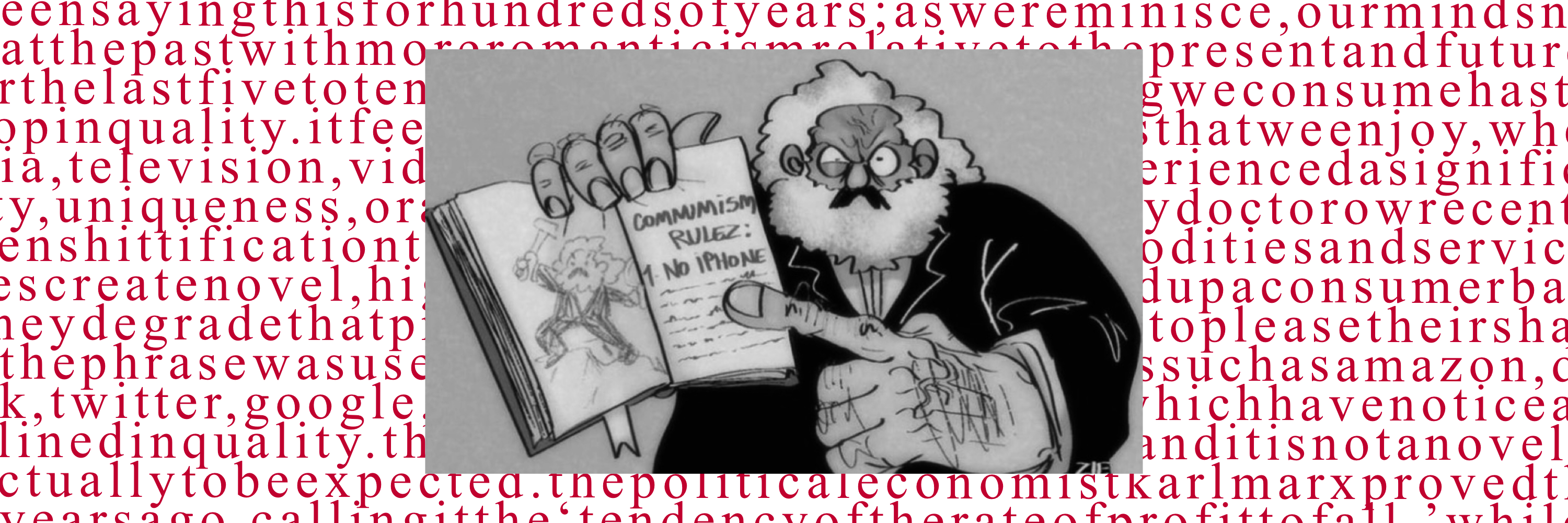
This phenomenon is not random, and it’s not a novel concept either. It’s actually to be expected. The 19th-century political economist Karl Marx proved this concept over 150 years ago, calling it the ‘Tendency of the Rate of Profit to Fall.’ While he didn’t exactly say “nothing will ever beat 2017 Fortnite,” what he did say is that, because of the profit motive, capitalist companies must constantly increase their rate of profit and thus efficiency. The need to improve efficiency leads to all sorts of cost-cutting measures, leaving us, the consumer, with a diminished product.
In simple terms, capitalist companies exist to make profit. Marx was aware of this and took the next logical step. He realized that companies don’t just make a profit; there is an inherent incentive structure in capitalism that makes profit necessary. Capitalist owners need to reinvest some of their revenue back into the company so it runs more efficiently, generating more profit than they initially invested. On top of that, they’re competing with other companies to capture a larger share of the total profit. In order to beat everyone else, they have to find creative ways to reduce production costs or get away with charging more for their products. And on top of that, they have an obligation to their shareholders to pay dividends and deliver increasing profits, so their stock value goes up. For capitalists, the game of profit is zero-sum; if their company becomes less efficient— meaning their workers are paid too well, they’re charging too little for products, or they’re not getting returns on development— then their investors sell their shares, and the company starts to die off.
With this in mind, Marx’s law states that investors not only demand profit, but also a higher rate of profit, because it’s only worth an investor’s time to invest in the most efficient and thus most profitable companies. On the scale of the entire market, companies that make the ‘wrong’ decisions in this profit game die off, get acquired by a larger firm, or are eaten up by private equity. The big companies we know today– Apple, Microsoft, Facebook, Google, and Amazon– are the companies that have survived this ruthless process. Marx concluded that this system is untenable because it is impossible to infinitely increase profit on an Earth of finite resources. That’s precisely why we experience stock market crashes or collapses every 5 to 10 years: the system cannot sustain the rate of profit growth.
Liberal economists and capitalism apologists say that competition between corporations forces them to produce better products, like a race between two athletes that produces the fastest times. However, they neglect that, unlike athletes, the loser in the business world dies or gets acquired by the winning firms. This is how monopolies are created. The longer this process of monopolization goes on unchecked, and the more the economy becomes centralized in the hands of a few massive multinational corporations, the less competition there is and the worse the products get.
There’s also the problem that producing a better product isn’t the only way to increase profits. In fact, creating a better product is one of the most difficult tasks of a business, and takes the most investment. Especially under monopoly-like conditions, which is to say the current-day American economy, it is far cheaper to advertise, cut production costs, cut product quality, and lobby the government than do the hard work of researching and development. Especially when many of these monopoly companies, like Facebook, have expanded so widely and have achieved complete market dominance, improving their service won’t attract any more customers… because there’s no one without a Facebook account left!
The Labor Theory of Value:
Before Marx synthesized the concept, Adam Smith and David Ricardo helped develop the idea that labor– the output of human workers– is the most basic unit of economic value. In other words, the creation of every commodity depends on labor; the one universal thing about everything in the economy is that humans must do work to make things. This means that new commodities (new value) cannot be created without labor. The only way value can be added to a product is through labor. This also means that the machines that help make products are not creating ‘new value.’ Machines are made by humans; when they are used to make other products, they are just giving a small bit of their own value to the creation process. Plus, machines cannot repair themselves or give themselves instructions on how to function; labor has to be involved somewhere in the productive process. Thus, human labor is the only universal factor common to all economic activity.
Though it is only the tip of the iceberg of this theory, it is already a more nuanced method for understanding value than the subjective value theory taught by liberal economists, which explains value only through supply-and-demand market forces.
From his examination of how capitalism operates, he found that companies are forced to keep investing in better machines and automation to boost efficiency, beat competitors, and survive. This investment increases efficiency but replaces the workers. At the same time, the better machines are not creating new value; they’re just using up the value given to them when they were made. Keeping all other factors constant, the long-term trend would be that profit rates fall because labor, the only thing that can produce new value, is becoming a smaller and smaller proportion of the production process. To combat this trend, the only choice for corporations is to double down by reducing wages, expanding to new markets, exploiting the resources and labor of the third world, increasing prices, and finding creative ways to charge more for less.
The concept of ‘charging more for less’ is something we encounter frequently in our day-to-day lives as consumers. We saw it especially with ‘shrinkflation’ after the pandemic. Food companies and restaurants have decided to start charging more for the same thing or package their products differently to give you less for the same price. The cost of a Chipotle bowl, for example, went from an average of less than $7.50 to over $10.50 in about 5 years. Add in chips and a drink, and you’re looking at close to $20. Less than a decade ago, finding a meal for under $10 was a fair deal; now, that same meal is a good deal if you can find it for under $20. Tech companies like Apple and Samsung have seemed to slow the speed at which new features are added to their devices. Smartphones have reached a limit where each yearly iteration hardly improves over the previous year’s model, while the price remains the same or increases.
Recently, we’ve seen a wave of nostalgia-baiting movies and shows rather than brand-new, unique titles. Take remade movies like the live-action Lion King, which adds very little while removing all the animated charm of the original. When Disney acquired the IP rights to Star Wars, it immediately began milking the franchise for five more movies and a number of television series, with mixed results (except for the excellent Andor series). Speaking of milking, this year’s Minecraft Movie was such an unapologetic cash grab that became a success purely because Gen-Z ironically celebrated it in TikTok trends. The entire industry, whether it’s the few monopoly studios or Netflix, has completely prioritized sequels and adaptations of other media over original stories. Without a comprehensive list of examples, we can trace much of the laziness and lack of risk-taking in the film industry to the need to increase profit. Why risk a creative flop when you have existing mass appeal cash cows?
This also applies to video games. The AAA studios also realized that once they have a core fanbase that consistently buys their games every year, innovation and creativity can take a back seat. This is most obvious in sports games (Madden, NBA 2K, FIFA, etc.), which see hardly any new content year after year, yet they continue to be re-released for $70 rather than being updated like every other game. Activision perfected this with its household-name franchise, Call of Duty, which is entering its 22nd consecutive release and utilizes three entire development studios each year. This franchise is infamous for nostalgia baiting, making marginal changes, and recycling its fan base to the point where it now has multiple games with the exact same name (Modern Warfare 2007, 2016 & 2019, Modern Warfare II 2009 & 2022, Modern Warfare III 2011 & 2023).
When microtransactions began to be implemented in the mid-2010s, the industry realized that designing a game around digital items, which requires far less effort to develop than the core game, generates dramatically more profit. Practically no major online multiplayer title today ships without purchasable cosmetic items. This led to the rise of ‘season passes,’ a model that has permeated every game genre, where players can pay $10-$20 a couple of times per year to unlock better limited-time cosmetic items as they level up. For companies, the outright purchase model was limited, as only a small number of ‘whales’ accounted for most of the purchases. Players, however, actually prefer to earn cosmetic items rather than buy them with money. In contrast, season passes lowered the purchase barrier to entry while giving them something to work for. It’s the sweet spot that generates the most profit and ensures you’re spending more than you would’ve otherwise. Commodifying something that doesn’t need to be commodified is an evergreen tactic capitalists use to squeeze consumers.
In terms of innovation, social media has a low ceiling. There are only so many different ways to design a platform. Thus, companies resort to squeezing more profit by ramping up advertising and filling our feeds with slop and AI-generated content. We’re probably well aware by now how companies farm our attention, intentionally keeping us engaged with content to better serve us ads. Through its intense algorithm, TikTok is infamous for locking users into a ‘doomscroll’ where short-form videos in an easily scrollable format become addictive. Despite countless studies being performed on the ill effects of addictive social media, companies have only ramped up the content farm. Simultaneously, they’ve also neutered the content on their platforms to please advertisers who are worried that their content appears alongside harmful or controversial content. Though this has positively reduced the amount of overt bigotry we see online, it’s also led to an overall drop in monetization for all creators across the board and more or less forced them to self-censor context-neutral words like ‘kill’ or ‘suicide.’
In all parts of our lives, we’ve seen a universal shift towards ‘subscription-based’ services, particularly for things that shouldn’t require a subscription, such as laundry detergent, car radios, printer ink, and basic groceries. Depending on the product, this model may save some people money, but companies know that, for the majority of users, a subscription generates more money long term because people forget to cancel or don’t utilize the service to its fullest potential.
Inevitably, all this merciless profit-seeking culminates in market crashes where the balancing act collapses. Eventually, the entire capitalist system runs out of ways to extract more profit; it quite literally runs into the boundaries of reality. That is exactly what we’re seeing today: the world is on a collision course with climate collapse, and companies are only accelerating their reliance on AI, which consumes massive amounts of energy with very little return on productivity. The only way to escape this vicious cycle is to tear down the capitalist system and build a socialist economy in its place, where workers are paid the actual value of their labor, and where the things we enjoy are created for us, not for profit. We cannot reform capitalism; so long as there is a structure that supports the profit motive, it will continue to degrade not just our entertainment but the entire Earth.